
Imagine you have a great idea for a product.
You identify a problem, speak to developers, design the application, and launch it. You feel excited because your product is finally live.
But what happens next?
- What if people don’t use your product?
- What if customers try it once but never return?
- What if competitors launch something better?
- What if your product becomes outdated?
- What if your users want something completely different after two years?
- What if adding more features makes the product more complicated rather than better?
This is where the real responsibility of a Product Manager begins.
Building a product is about turning an idea into something people can use. Product management is about ensuring that the product continues to solve meaningful problems, delivers value to customers, and supports the business over time.
A product isn’t a one-time project. It is an evolving system that requires continuous learning, decision-making, and adaptation.
In this article, we will explore the complete product lifecycle in simple language, using practical case studies to understand what a Product Manager does at each stage.
Section 1: What Is the Product Lifecycle?
In simple terms, the product lifecycle is the journey a product takes from its initial idea to the point where it is improved, transformed, or eventually retired.
Think about a restaurant.
Someone has an idea to open a restaurant. They research the customers, choose the location, design the menu, open the doors, attract customers, improve the food, and adapt when customer preferences change.
A product follows a similar journey.
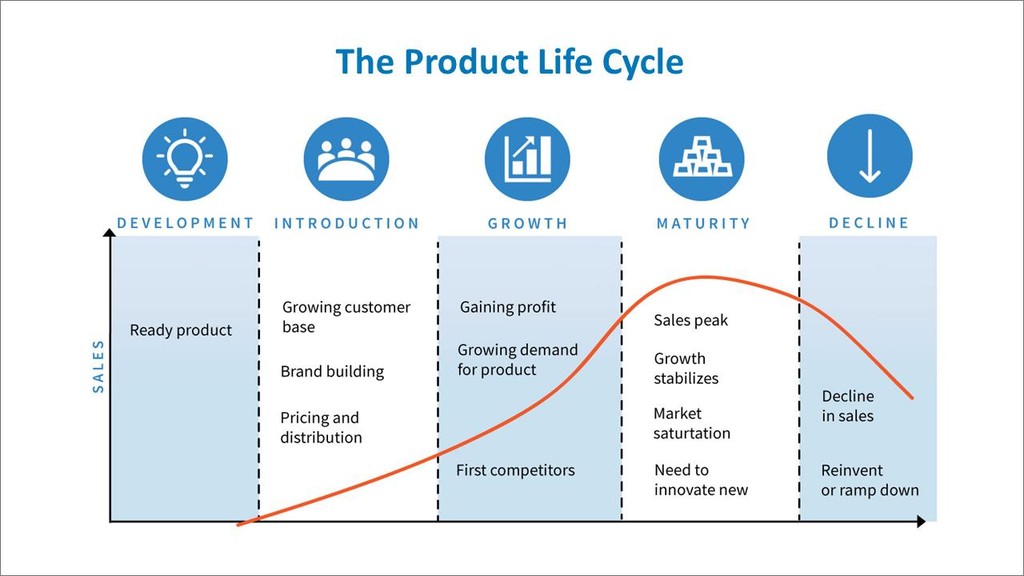
The six practical stages
1. Discovery
Find out what problem is worth solving.
2. Development
Build and test a solution.
3. Launch
Introduce the product to its intended market.
4. Growth
Attract users, improve retention, and expand.
5. Maturity
Keep the product valuable in a competitive market.
6. Transformation or Retirement
Adapt, reposition, replace, or stop the product when justified.
These stages aren’t always linear. A product may return to discovery when a new customer problem emerges, and some products never experience a significant decline.
Section 2: Stage One – Discovery: Why Are We Building This Product?
In simple terms
Before you build anything, you need to understand why the product should exist.
A common mistake is to start with a solution instead of a problem.
For example:
“Let’s build an AI chatbot for hospitals.”
That sounds exciting, but what problem will the chatbot solve?
- Are administrative staff spending too much time answering patient questions?
- Are patients struggling to book appointments?
- Are staff manually searching through internal records?
- Is there a problem that existing software doesn’t solve well?
A Product Manager needs to investigate before deciding what to build.
What does a PM do during discovery?
Interview customers and understand their problems.
Research competitors and existing solutions.
Identify the target customer and their needs.
Determine whether the problem is valuable enough to solve.
Define success metrics and test assumptions.
Case study: Airbnb
Airbnb’s early concept was built around helping people find accommodation in other people’s homes. Its founders tested the idea by hosting guests in their own apartment and later focused on improving the experience for hosts and guests.
Product management lesson: Start by understanding the customer problem and validating demand before investing heavily in a complete solution.
The broader lesson from Airbnb’s growth is that a product needs more than a functional idea. It needs a compelling customer experience and a model that can support growth.
Example: AI healthcare scheduling
Imagine you are the Product Manager for a healthcare scheduling platform.
Instead of immediately requesting a scheduling application, you interview clinic administrators.
You discover:
“We spend hours every day manually coordinating appointments, and patients often miss reminders.”
You now have a problem to investigate. You can explore whether automation, better reminders, or improved scheduling workflows would address the underlying needs.
Key takeaway: A Product Manager does not simply ask, “What should we build?” They ask, “What problem is worth solving, for whom, and why?”
Section 3: Stage Two – Product Strategy: Deciding What to Build and Why
In simple terms
Once you understand the problem, you need a direction.
Product strategy is your plan for answering:
“Where are we going, who are we serving, and how will this product create value?”
A product can solve a real problem and still fail if it targets the wrong market, has no sustainable business model, or lacks a clear direction.
The four key questions
| Question | Example |
|---|---|
| Who? | Small and medium-sized healthcare clinics |
| What problem? | Manual appointment coordination |
| What solution? | Scheduling and workflow automation |
| Why us? | A workflow tailored to the clinic’s needs |
A Product Manager works with business leaders, designers, engineers, and other stakeholders to establish a shared product direction.
What should a product strategy include?
- Product vision: What future are we trying to create?
- Target customers: Who will benefit from the product?
- Value proposition: Why would they choose our solution?
- Business model: How will the product support the business?
- Strategic priorities: What should we focus on first?
- Success measures: How will we know if we are progressing?
A roadmap is not the strategy itself. A roadmap communicates planned direction and priorities, while strategy explains the choices behind them.
Section 4: Stage Three – Development: Turning the Strategy Into a Working Product
In simple terms
Now you have identified the problem and decided on a direction. It’s time to build.
This is the stage where the Product Manager works closely with developers, designers, QA engineers, and other stakeholders.
But development doesn’t mean building every idea that someone suggests.
The goal is to build a solution that tests your most important assumptions and delivers useful customer value.
Example: Building a healthcare MVP
Your research shows that clinic staff need a better way to manage appointment reminders.
Instead of building an entire hospital management platform, your first version might include:
- Appointment scheduling.
- Automated reminders.
- Basic staff dashboard.
- Appointment status tracking.
You launch a limited version to test whether the workflow solves the problem.
What does a PM do?
Define and prioritise requirements.
Collaborate with designers on usability.
Work with engineering on feasibility and trade-offs.
Manage scope, dependencies, risks, and priorities.
Validate the product through testing and customer feedback.
Important distinction: MVP vs. incomplete product
An MVP (Minimum Viable Product) is a deliberately limited product designed to test assumptions and provide value to a specific group of users.
It is not an excuse to deliver something unsafe, unusable, or poorly designed.
In healthcare, privacy, security, safety, and regulatory obligations must be considered from the beginning.
Section 5: Stage Four – Launch: Getting the Product Into the Market
In simple terms
You have built the product. Now you need people to use it.
Launching is not simply pressing a button and announcing that the product is live.
You need to make sure the right customers know about it, can access it, understand its value, and can successfully use it.
The launch checklist
Product Launch Checklist
Identify the target market and launch audience.Prepare positioning and product messaging.Coordinate sales, marketing, support, and engineering.Test onboarding and the core user experience.Define rollout and monitoring plans.Track initial adoption and user feedback.
Example
You launch your healthcare scheduling platform with five clinics.
You monitor:
- How many staff members activate their accounts?
- How long does it take them to schedule an appointment?
- Are reminders being sent successfully?
- Do staff continue using the platform after the first week?
- What problems do users report?
These metrics help you understand whether the launch is achieving its intended outcomes.
A successful launch is not necessarily a successful product. You need evidence that customers continue to receive value.
Section 6: Stage Five – Growth: Moving From Initial Users to Sustainable Adoption
In simple terms
Your product is live, and people are using it. Now the question becomes:
“How do we attract more of the right customers and ensure existing customers continue receiving value?”
Growth is more than increasing the number of users. It involves improving adoption, retention, customer value, and the sustainability of the business.
Three important concepts
Acquisition
How do we bring new customers into the product?
Activation
Do new users reach the product’s initial value successfully?
Retention
Do customers continue using the product over time?
Case study: Slack
Slack grew as a workplace communication product by focusing on how teams communicate and collaborate. Its product experience, integrations, and team-based usage are useful examples of the importance of making a product easy to adopt and valuable in ongoing workflows.
The lesson for a PM is to understand the difference between someone signing up and a team genuinely incorporating the product into its work.
Example: Your healthcare product
Suppose your platform has 20 clinics registered, but only 8 use the automated reminder feature regularly.
You should investigate:
- Is the feature difficult to configure?
- Do clinics understand its benefits?
- Are reminders reliable?
- Does the workflow fit existing staff routines?
- Are there barriers to onboarding?
Instead of automatically building another feature, you might improve onboarding, simplify configuration, or fix reliability issues.
Growth often comes from improving the existing experience, not just adding more functionality.
Section 7: Stage Six – Maturity: When Growth Starts to Slow Down
In simple terms
Your product has become established. Customers know about it, competitors may offer similar solutions, and the number of new users may grow more slowly.
This is the maturity stage.
But maturity does not mean the product is failing. It means the product may need a different strategy from the one that worked during early growth.
What changes during maturity?
During early growth, the team may focus heavily on:
- Acquiring new users.
- Expanding distribution.
- Improving activation.
- Scaling the product.
During maturity, priorities may increasingly include:
- Retaining existing customers.
- Improving profitability and operational efficiency.
- Defending against competitors.
- Serving new customer segments.
- Improving reliability and usability.
- Identifying new opportunities for growth.
The precise priorities depend on the business model and product.
Example: A mature healthcare SaaS platform
Your scheduling product now serves 500 clinics.
Growth is slowing, but the existing customer base is valuable.
The team could explore:
- Improving the reliability of appointment reminders.
- Introducing integrations with existing practice management systems.
- Expanding into additional clinic workflows.
- Improving reporting and analytics.
- Testing pricing or packaging changes based on customer needs.
The Product Manager needs to assess which opportunities are worth pursuing rather than assuming every possible feature should be built.
Key question
“How do we continue delivering value when simply acquiring more users is no longer enough?”
Section 8: Stage Seven – Decline: When the Product Starts Losing Relevance
In simple terms
Decline occurs when demand, usage, revenue, or strategic relevance decreases. It may happen because of technological changes, new competitors, changing customer preferences, or a problem with the product itself.
Decline is a signal to investigate, not an automatic instruction to shut down the product.
A drop in usage could mean the product is outdated. It could also mean customers are experiencing technical problems, pricing has changed, or the market has shifted.
What should a Product Manager investigate?
1. Why is usage declining?
Examine customer behaviour, feedback, and product analytics.
2. Is the customer problem still relevant?
Understand whether user needs or workflows have changed.
3. What is happening in the market?
Study competition, technology, pricing, and alternative solutions.
4. What options are available?
Consider improving, repositioning, rebuilding, or retiring the product.
Section 9: What Should You Do When a Product Starts Declining?
This is one of the most important decisions a Product Manager may face.
Imagine that your healthcare scheduling product is losing customers. The team proposes three options.
Option 1: Improve the Existing Product
Enhance
When it may make sense
Customers still value the product, but they face usability issues, missing functionality, or reliability problems.
Example: Simplify the booking workflow and improve appointment reminders.
Option 2: Transform or Reposition
Adapt
When it may make sense
The underlying customer need remains relevant, but the market or technology has changed.
Example: Evolve a basic scheduling tool into a broader workflow automation platform if research validates that opportunity.
Option 3: Retire the Product
Sunset
When it may make sense
The product no longer delivers sufficient value, the costs are unsustainable, or a replacement offers a better strategic path.
Example: Retire a legacy scheduling system after a supported migration path has been established for affected customers.
A simple decision framework
| Question | What it helps determine |
|---|---|
| Do customers still need the solution? | Whether the underlying problem remains valuable |
| Can the product be improved effectively? | Whether investment in the current product is justified |
| Is there a viable market opportunity? | Whether repositioning or expansion is worth exploring |
| What are the costs and risks? | Whether continued investment is sustainable |
| Can customers transition safely? | Whether retirement is feasible and responsible |
A Product Manager should use evidence, not personal attachment to a product or pressure to keep releasing features.
Conclusion: A Product Is Never Truly Finished
A product may be launched, but its journey doesn’t end there.
Customer needs change. Technology evolves. Competitors enter the market. Business priorities shift. Products need to adapt to remain valuable.
The Product Manager’s responsibility is to guide the product through these changes.
Sometimes the right decision is to build a feature. Sometimes it is to simplify the experience. Sometimes it is to explore a new market or business model. And sometimes the responsible decision is to retire a product and help customers transition to a better alternative.
The true value of Product Management lies not just in building something, but in continuously understanding whether what you have built still deserves to exist, how it should evolve, and what value it should create next.
A Product Manager should always be asking:
“Are we still solving the right problem for the right customer, in the right way, at the right time?”
That is the mindset that turns product development into meaningful product management.
Leave a Reply